
A second-year engineering student at Mumbai's Institute of Chemical Technology (ICT), Siddhesh Patil, died by suicide in his hostel room. Patil, a native of Nashik, was undergoing treatment for depression and had messaged his psychiatrist about suicidal ideation on Tuesday night, prompting an alert to his family and friends. Police have registered an Accidental Death Report and are investigating the incident.

Researchers at IIT Madras have patented a chemical-free antibacterial surface that physically eliminates harmful bacteria, including "superbugs," without relying on antibiotics or disinfectants. This innovative technology uses specially engineered nanostructures to rupture bacterial cell walls, offering a sustainable solution to Antimicrobial Resistance (AMR) for biomedical and public health applications.

Researchers at IIT Indore have developed a groundbreaking method to convert carbon dioxide and glycerol, two common waste materials, into valuable green chemicals like lactic acid and formic acid in just seven minutes. This low-energy process uses a specially designed ruthenium-based catalyst and microwave heating, offering a sustainable solution for waste management and green manufacturing.
Researchers at the Indian Institute of Technology Bombay have developed an innovative, low-cost device capable of screening for anaemia and sickle cell disease using just a single drop of blood. This point-of-care approach measures blood smear length to detect differences in viscosity, which are indicative of these conditions. The patented device is designed for cost-effective manufacturing and ease of use, making it ideal for areas with limited access to conventional diagnostic laboratories. The technology is currently licensed to an IIT Bombay startup and is moving towards regulatory approval.
The ICAR-Central Institute of Fisheries Technology (ICAR-CIFT) has secured an Indian patent for a novel technology designed to make live fish and aquatic animal transport safer and more efficient without the use of chemicals. This innovative system employs controlled hypothermic anaesthetisation, gradually cooling aquatic animals to prevent shock and improve survival rates during transit, offering a practical and affordable solution for the seafood industry.
Researchers at NIT Rourkela have developed a novel material from discarded jackfruit peels, capable of removing over 90% of fluoride from contaminated water in about 10 minutes under laboratory conditions. This patented technology, which uses activated carbon modified with zirconium, offers a promising, cost-effective, and sustainable solution for decentralised water treatment, particularly in fluoride-affected regions of India.
Researchers at BRIC-RGCB in Thiruvananthapuram have developed a novel nanopore-based sensing technology. This innovation allows for the early and highly sensitive detection of biomarkers associated with neurodegenerative diseases like Parkinson's and ALS, addressing a critical challenge in current diagnostic methods. The technology, published in Nature Nanotechnology, uses self-assembling dual-diameter nanopore sensors to identify disease-specific biomarkers even at low concentrations.

Researchers at the Indian Institute of Technology (IIT), Guwahati, have developed an innovative nature-based wastewater treatment system utilising taro plants and an engineered "zig-zag flow" design. This low-energy, compact technology offers a promising solution for treating highly polluted swine wastewater in decentralised livestock farms, particularly in rural and resource-limited regions.

rediffGURU Nayagam PP, founder of EduJob360, offers guidance on how to pick the right college and course for your future.
Researchers from IIT Guwahati and BHU have devised an eco-friendly biological method to treat textile wastewater, specifically targeting toxic azo dyes. Their novel bacterium, 'Brevundimonas sp. AJZ05', effectively degrades 98.50 per cent of Direct Blue-6 dye, producing non-toxic byproducts, offering a sustainable alternative to conventional chemical treatments.

Researchers at Delhi's Indraprastha Institute of Information Technology have developed 'MutAIverse', a generative AI platform designed to decode DNA damage and identify potential causes of cancer. Tested on head and neck cancer patients in Guwahati, the platform successfully traced exposure to smokeless tobacco as a contributing factor. This innovation aims to shift focus from just diagnosis to understanding causative factors, potentially aiding in prevention and protection.

Industry experts advocate for India to develop its own artificial intelligence (AI) safety framework, distinct from US or EU models, to address unique challenges like deepfakes and cyberattacks. They call for a comprehensive commitment involving all stakeholders and a hybrid regulatory approach combining voluntary and binding measures, as the Indian government also considers new AI regulations.

Gautam Adani and family have reclaimed the top spot on India's rich list, surpassing Mukesh Ambani, as the nation's billionaire population reached a record 391, according to the M3M Hurun India Rich List.
Six faculty members from IIT Madras have been awarded the prestigious ANRF J C Bose Grant, recognising their outstanding research contributions in engineering and science. The highly competitive grant provides Rs 25 lakh annually for five years to support frontier research.

For India, the goal is not simply to host another grand diplomatic gathering. It is to prove that a diverse coalition of emerging powers can still deliver.

E-Eye, which cost about Rs 3,500 to develop, can test a sample for around Rs 2, making it particularly suitable for field-level water quality monitoring in areas where access to sophisticated laboratories is limited.
Researchers at IIT Indore have developed a non-invasive technique to detect early signs of oral cancer using saliva and a swab sample. This method is economical, quick, and aims to make early screening more accessible, especially in rural areas, offering an alternative to painful biopsies. The findings, published in the British Journal of Cancer, show distinctive molecular changes before the disease becomes clinically obvious.

Researchers at IIT-Guwahati have developed an inexpensive and efficient catalyst for producing hydrogen from water, a crucial step for the National Green Hydrogen Mission and the transition to sustainable energy. The catalyst uses nickel salt and an anthracene-based organic molecule, offering a cleaner alternative to fossil fuel-derived hydrogen.
Researchers at IIT-Guwahati have identified a type of blue-green algae (cyanobacteria) that can effectively remove lead from contaminated water. The study highlights the role of exopolysaccharides (EPS) produced by the algae in absorbing lead, with laboratory experiments showing up to 66.2% removal. This discovery offers a promising, naturally abundant solution for water purification, though further validation is needed before commercial application.

IIT-Guwahati has partnered with Kaashyap Cleantech Innovations to commercialise bio-methanol production technology, which converts greenhouse gases into a versatile liquid fuel, offering environmental and performance benefits.

'Think of the brain like a machine, and Alzheimer's is like rust.'
'Like a rusty machine breaks down, a rusty brain also breaks down. And when it breaks down, you have memory loss, cognitive issues and so on.'

IIT Bhubaneswar researchers have developed 'ArsenSafe', a portable, low-cost device for rapid, on-site detection of arsenic in drinking water. This innovation aims to address the critical public health challenge of arsenic contamination in groundwater, offering a solution that doesn't require laboratory infrastructure.

Many successful careers begin from ordinary colleges, says rediffGURU Radheshyam Zanwar as he guides worried a class 12 student who was unable to secure admission at an IIT.

'Our problem is not a budget deficit but a trust deficit. We need to trust our institutions and industries to innovate and lead. That is the way forward for India.'
A new study reveals that herbal cigarettes, often marketed as a safe alternative to tobacco, produce emissions that are comparably or even more damaging than regular tobacco cigarettes.

Billionaire Mukesh Ambani announced that the transfer of day-to-day management responsibilities at Reliance Industries to his children, Akash, Isha, and Anant, is "almost complete," marking the final stages of a significant succession process for India's most valuable company.

The latest QS World University Rankings reveal that several Indian institutions, including IITs, JNU, and BITS Pilani, have secured positions among the world's top 50 in various subjects.

Kerala's Home Minister announces 'Operation Toofan: The Narco Hunt', a statewide campaign to crack down on drug syndicates, focusing on eliminating drug distribution networks, especially around educational institutions, and improving police functioning across the state.
Reliance Industries chairman and managing director Mukesh Ambani announced an unconditional grant of Rs 151 crore to his alma mater the Institute of Chemical Technology, Mumbai. Ambani had graduated from ICT in the 1970s.
Kerala's Home Minister announces 'Operation Toofan: The Narco Hunt', a comprehensive anti-narcotics campaign targeting drug syndicates, especially those operating near educational institutions, and outlines reforms to improve police functioning and public accessibility.
Scientists at the GraphIN 2026 conference in Kochi highlighted graphene's potential in water purification, discussing graphene-based membranes and nanocomposites for removing pollutants and improving desalination.

A new research collaboration between India and Sweden is using artificial intelligence to accelerate the discovery of peptide-based therapeutics for pneumonia, aiming to shorten drug development timelines and combat drug-resistant infections.

While India's interplanetary ambitions remain significant, the current pace of financial and technical progress raises questions about whether the 2027-2028 timelines can be met.

Scientists at the GraphIN 2026 conference highlighted the potential of ultra-sensitive graphene sensors for rapid disease detection and various other applications, including flexible heating pads for neonatal care and lightweight structures for unmanned aerial vehicles.
Researchers at IIT Bombay have developed a DNA-based strategy to make drug-resistant bacteria responsive to antibiotics again, addressing the growing crisis of antimicrobial resistance.

Nine people remain missing following the explosion at the Sigachi Industries' pharma plant in Pashamylaram, Telangana, which claimed 38 lives. An expert committee is investigating the cause of the blast.

The 'rescue' operation occurred within kilometres of Iran's underground tunnel complex at Isfahan, assessed by the IAEA and US intelligence as holding a substantial portion of the country's 60 per cent enriched uranium stockpile. Retired senior US military officers have highlighted that the mission's footprint -- hundreds of special operators, multiple heavy-lift aircraft deep inside Iran -- appears outsized for recovering a single airman. Prem Panicker continues his must read blog on the Iran War.

Usually, in the western view, corporate success is attributed to efficiency, organisational structure, and scale. R Gopalakrishnan and Harish Bhat argue that philosophy, culture, and the transmission of values are more important for sustaining growth and profitability of an enterprise over a period of time.

rediffGURU Chocko Valliappa offers crucial career advice to engineering aspirants.
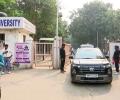
The Association of Indian Universities (AIU) has suspended the membership of Al Falah University due to its connection to the Red Fort blast case.
